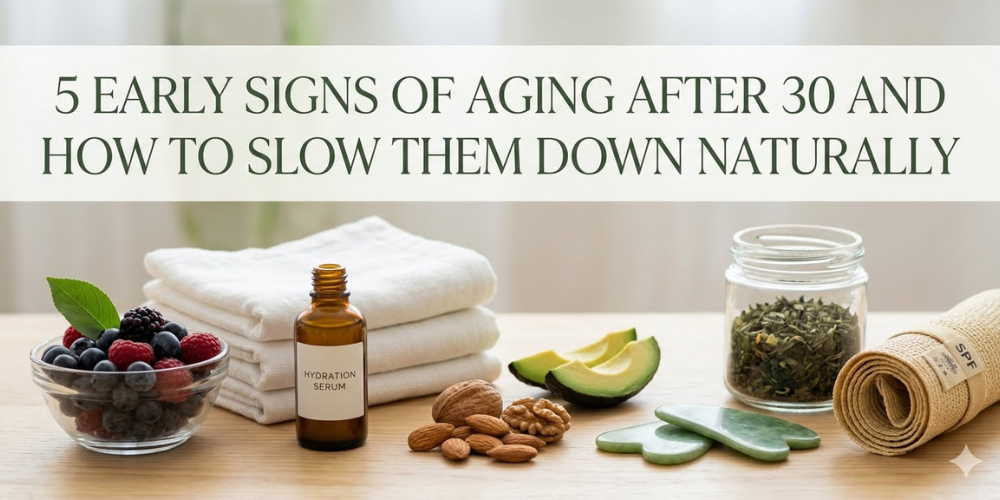


5 Early Signs of Aging After 30 and How to Slow Them Down Naturally
Introduction
After 30, aging does not appear suddenly — it begins at a cellular level long before it becomes visible. Collagen production gradually slows, skin cell turnover decreases, and the body becomes slightly less efficient at repair and regeneration.
At this stage, the changes are still subtle and highly responsive to lifestyle. This is why the early 30s are considered a critical window for prevention — small daily choices can significantly delay visible aging over the next decade.
Table of Contents
The 5 Early Aging Signs After 30
Fine lines and early expression wrinkles
These lines appear because collagen and elastin — the structural proteins that keep skin smooth and firm — begin to decline gradually from the late 20s onward. Repeated facial movements then become more “etched” into the skin instead of fading quickly as before.
This is often first noticed around the eyes and forehead, where skin is thinner and more exposed to movement and sunlight.
Loss of skin firmness and elasticity
Skin firmness depends on the strength of the dermal matrix, which weakens over time due to reduced collagen density and slower fibroblast activity.
As a result, the skin may not “bounce back” as quickly after expression or pressure, creating a gradual loss of tightness in the lower face and jawline.
Dull and uneven skin appearance
Skin renewal slows down as the natural exfoliation cycle becomes longer. Dead skin cells remain on the surface for a longer time, blocking light reflection and reducing glow.
At the same time, oxidative stress from pollution and UV exposure can increase pigmentation irregularities, making the skin tone look less uniform.
Hair weakening and increased shedding
Hair follicles are highly sensitive to hormonal balance and nutrient availability. After 30, subtle shifts in hormones and reduced microcirculation to the scalp can affect follicle strength.
This can lead to thinner hair strands, reduced density, and increased shedding during washing or brushing.
Lower energy and slower metabolic response
Metabolism is closely linked to muscle mass, mitochondrial efficiency, and hormonal signaling. After 30, muscle mass can slowly decline if not actively maintained, which affects overall energy expenditure.
This often results in easier fatigue, slower recovery, and gradual weight gain even without major lifestyle changes.
What Accelerates Early Aging
Early aging is not driven by chronological age alone. In fact, dermatology research shows that most visible aging signs are the result of cumulative environmental and lifestyle stressors that gradually damage collagen structure, cellular function, and skin repair mechanisms over time.
When these factors build up, they accelerate what is known as “extrinsic aging” — the type of aging influenced by daily habits and external exposure rather than genetics alone.
- Chronic UV exposure: Repeated sun exposure is the leading cause of premature aging. UV radiation penetrates deep into the dermis, breaking down collagen and elastin fibers, which leads to thinning skin, fine lines, and uneven pigmentation over time.
- Low antioxidant protection: A diet lacking in antioxidants reduces the body’s ability to neutralize free radicals. This imbalance increases oxidative stress, which damages skin cells and accelerates visible aging at a cellular level.
- Persistent psychological stress: Chronic stress elevates cortisol levels, which disrupts collagen production, weakens skin barrier function, and can also affect hormonal balance linked to hair and skin health.
- Poor sleep quality: During deep sleep, the body activates repair and regeneration processes, including growth hormone release and collagen rebuilding. Disrupted sleep reduces these repair cycles, making aging signs appear earlier and more pronounced.
- High sugar consumption: Excess sugar triggers a process called glycation, where sugar molecules bind to collagen fibers, making them stiff, weak, and less elastic — a key contributor to sagging skin and wrinkles.
- Environmental pollution: Air pollutants increase oxidative stress on skin cells, weakening the skin barrier, accelerating pigmentation issues, and contributing to premature hair and skin aging.
How to Slow Down Aging Naturally
Modern dermatology emphasizes that early aging is largely preventable when targeted lifestyle and nutritional strategies are applied consistently. Supporting the body’s natural repair systems can significantly delay visible aging signs.
Strengthen collagen and structural integrity
Collagen degradation is one of the earliest biological changes after 30. Supporting collagen synthesis through adequate protein intake, vitamin C, and essential amino acids helps maintain skin firmness, elasticity, and structural resilience.
Protect against UV and environmental damage
Daily sunscreen use is one of the most effective anti-aging strategies in dermatology. UV protection prevents photoaging — the primary cause of premature wrinkles, dark spots, and skin texture changes.
Improve antioxidant and cellular nutrition
A nutrient-rich diet helps protect cells from oxidative stress. Key compounds such as vitamin E, polyphenols, carotenoids, and omega-3 fatty acids support skin barrier integrity and reduce inflammation linked to aging.
Optimize sleep for repair and regeneration
Sleep is the body’s primary repair phase. Consistent, high-quality sleep supports collagen synthesis, hormone regulation, and cellular detoxification. Poor sleep quality is strongly associated with accelerated visible aging.
Support metabolic, hormonal, and hair health
Micronutrients such as iron, zinc, biotin, magnesium, and B-complex vitamins play a critical role in oxygen transport, follicle activity, energy production, and overall metabolic stability — all of which influence how quickly aging becomes visible.
Useful Related Resources
Explore science-backed aging support products and wellness solutions:
https://drnutrition.com/en-ae/search?q=age
FAQ
When do biological aging changes start?
They begin gradually in the mid-to-late 20s at a cellular level, even if not visible immediately.
Why does skin change after 30?
Because collagen production slows and skin cell turnover becomes less efficient over time.
Can early aging be reversed?
It cannot be fully reversed, but its progression and visibility can be significantly reduced.
What is the strongest anti-aging factor?
Consistent sun protection is the most evidence-backed method to slow visible aging.
Does diet affect aging speed?
Yes, diets high in antioxidants and protein slow aging, while high sugar intake accelerates it.
Why does hair thin with age?
Due to hormonal changes, reduced follicle activity, and nutrient deficiencies.
Can exercise slow aging?
Yes, it improves circulation, hormone balance, and mitochondrial function.
What is the first visible sign of aging?
Fine lines and changes in skin texture are usually the earliest noticeable signs.
Conclusion
Aging after 30 is not a sudden transformation but a gradual biological shift influenced heavily by lifestyle and environment.
Understanding early signs allows for early intervention — and with consistent care in nutrition, protection, and recovery, it is possible to maintain healthier skin, stronger hair, and stable energy for years to come.