
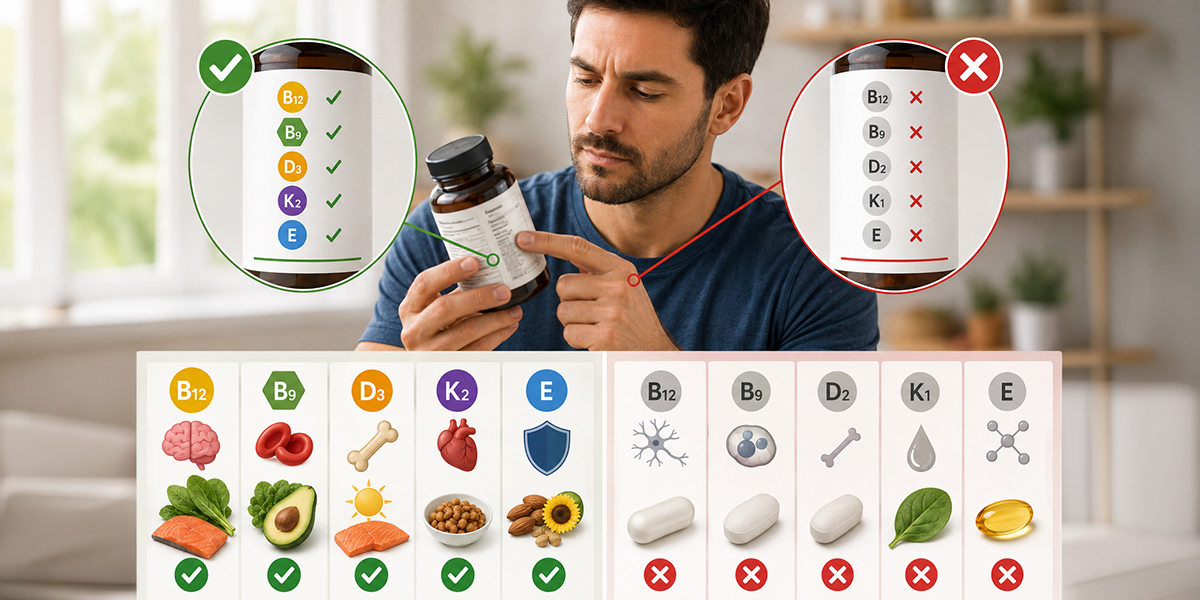


Reading supplement labels can sometimes feel confusing, especially with the wide variety of vitamin forms available on the market. Many consumers purchase supplements without realizing that some vitamins are provided in “active” forms that the body can use directly, while others require conversion before they become biologically active.
Understanding how to identify active vitamin forms on supplement labels can help you make more informed decisions and select products that better match your individual nutritional needs.
Table of Contents
What Are Active Vitamin Forms?
Active vitamin forms are versions of vitamins that can be utilized directly by the body without requiring significant conversion processes in the liver or other tissues.
These forms are often preferred by individuals who may have reduced ability to convert standard vitamin forms efficiently, although both active and non-active forms can contribute to meeting nutritional requirements.
How to Recognize Active Vitamin B12
When reading supplement labels, the active form of vitamin B12 is most commonly listed as Methylcobalamin.
Another active form sometimes used in premium supplements is Adenosylcobalamin.
By comparison, Cyanocobalamin is a commonly used form that requires conversion inside the body before becoming metabolically active.
How to Identify Active Folate
The active form of folate may appear under several names, including:
- L-Methylfolate
- 5-MTHF
- Methylfolate
- L-5-Methyltetrahydrofolate
Traditional Folic Acid is the synthetic form and requires conversion before the body can fully utilize it.
Recognizing Active Vitamin B6
The active form of vitamin B6 is typically listed as Pyridoxal-5-Phosphate (P5P).
This form is directly involved in many metabolic processes related to amino acid metabolism, neurotransmitter production, and energy metabolism.
In contrast, Pyridoxine Hydrochloride is a standard form that requires conversion before becoming active.
Identifying Active Vitamin B2
Active vitamin B2 is commonly listed as Riboflavin-5-Phosphate.
This form is readily available for use in cellular energy production and various enzyme systems throughout the body.
Standard Riboflavin remains effective but requires an additional conversion step before becoming fully active.
| Vitamin | Active Form | Common Non-Active Form |
|---|---|---|
| Vitamin B12 | Methylcobalamin | Cyanocobalamin |
| Folate | L-Methylfolate / 5-MTHF | Folic Acid |
| Vitamin B6 | Pyridoxal-5-Phosphate (P5P) | Pyridoxine HCl |
| Vitamin B2 | Riboflavin-5-Phosphate | Riboflavin |
Paying Attention to Ingredient Details
Many supplements contain a combination of active and non-active vitamin forms. Therefore, it is important to review the complete ingredient list rather than focusing only on the front label claims.
Some manufacturers prominently advertise active forms, while others may use standard forms because they are widely available and cost-effective.
Carefully reviewing ingredient names can help determine exactly which form is being provided and whether it aligns with your nutritional goals.
Frequently Asked Questions
What does “active vitamin” mean?
It refers to a form of a vitamin that can generally be used directly by the body without requiring major conversion steps.
Is methylcobalamin the active form of vitamin B12?
Yes. Methylcobalamin is one of the most commonly used active forms of vitamin B12.
How can I identify active folate on a supplement label?
Look for names such as L-Methylfolate, Methylfolate, or 5-MTHF.
What is P5P?
P5P stands for Pyridoxal-5-Phosphate, the active form of vitamin B6.
Are active forms always necessary?
Not necessarily. Individual needs vary, and both active and standard forms can play a role in supporting nutritional requirements.
Conclusion
Learning how to identify active vitamin forms on supplement labels allows consumers to better understand what they are purchasing and how different vitamin forms may fit their individual nutritional needs.
By carefully reading ingredient lists and recognizing names such as Methylcobalamin, L-Methylfolate, P5P, and Riboflavin-5-Phosphate, consumers can make more informed supplement choices while maintaining balanced nutrition as the foundation of overall health.