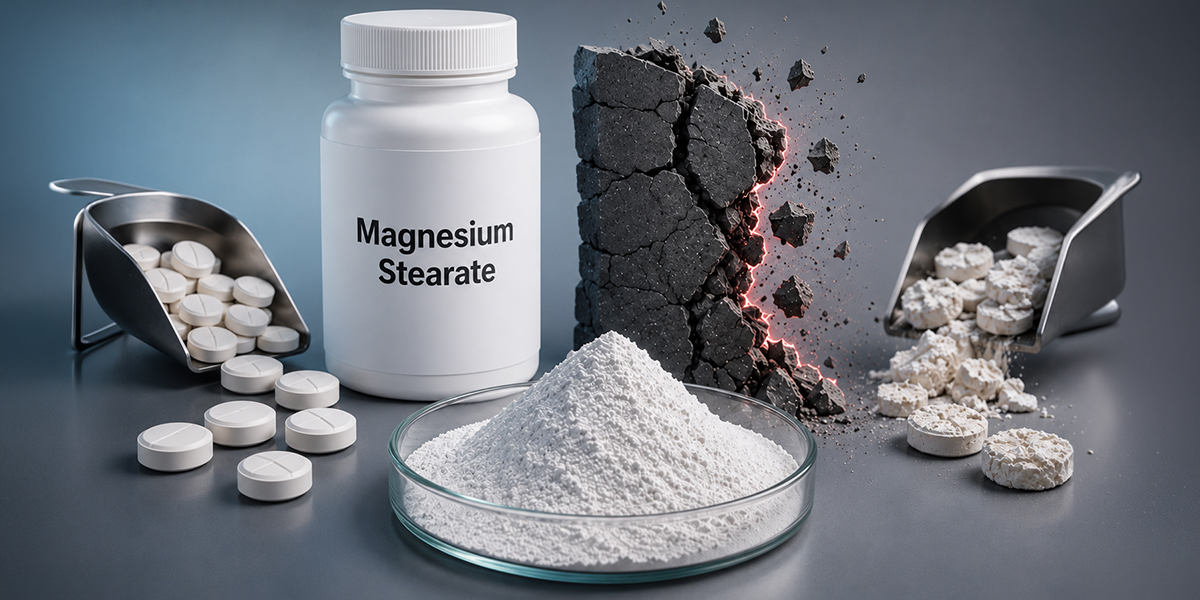


Magnesium stearate is one of the most commonly used additives in dietary supplements, capsules, tablets, and pharmaceutical products.
Because it often appears on ingredient labels, some consumers worry that it may be a harmful chemical or an unnecessary filler. However, understanding what magnesium stearate is and why it is used helps evaluate it from a scientific and practical perspective rather than relying on assumptions.
Table of Contents
What Is Magnesium Stearate?
Magnesium stearate is a compound made from magnesium and stearic acid.
Stearic acid is a fatty acid naturally found in many foods, including vegetable oils, cocoa butter, dairy products, meat, and other animal fats.
In supplement and pharmaceutical manufacturing, magnesium stearate appears as a fine white powder and is used mainly for technical manufacturing purposes rather than as an active nutritional ingredient.
What Is Its Function in Supplements?
Magnesium stearate is classified as an inactive excipient, meaning it is not the active ingredient responsible for the supplement’s main benefit.
Its primary function is to act as a lubricant during manufacturing. It helps prevent powders from sticking to machinery and allows ingredients to move smoothly through production equipment.
This is especially important in the production of tablets and capsules, where consistent filling, proper compression, and efficient manufacturing are needed.
- Helps powders flow smoothly during manufacturing.
- Prevents ingredients from sticking to equipment.
- Supports consistent capsule filling and tablet production.
- Improves manufacturing efficiency and product uniformity.
- Used in very small amounts compared with active ingredients.
Is It Absorbed by the Body?
When consumed, magnesium stearate is present in very small amounts and passes through the digestive system like other minor food and supplement components.
It can be broken down into magnesium and stearic acid, but it is not considered a meaningful source of dietary magnesium.
At typical supplement levels, magnesium stearate is considered functionally inactive and is used for processing rather than nutritional support.
| Point | Magnesium Stearate | Active Nutrient |
|---|---|---|
| Purpose | Manufacturing aid | Provides nutritional or functional benefit |
| Amount Used | Very small amounts | Listed as the main dose or active ingredient |
| Main Role | Prevents sticking and improves powder flow | Supports a specific health function |
| Nutritional Value | Not a significant magnesium source | Designed to contribute to nutrient intake |
Is Magnesium Stearate Harmful?
Based on current scientific understanding, there is no strong evidence showing that magnesium stearate is harmful at the levels commonly used in supplements and medications.
It is widely used in the supplement and pharmaceutical industries and is permitted by health and food regulatory authorities within approved limits.
For most people, the small amount found in capsules or tablets is not expected to cause health problems.
Why Do Some People Think It Is Harmful?
Concerns about magnesium stearate often arise because it is described as a chemical additive or excipient.
Some consumers may assume that any inactive ingredient is harmful, even though many excipients are used in very small quantities to help ensure product consistency, stability, and manufacturing quality.
There are also claims suggesting that magnesium stearate may coat nutrients or interfere with absorption, but these claims are not strongly supported at typical supplement usage levels.
- It sounds technical or chemical on the label.
- It is not an active nutrient, which can create confusion.
- Some marketing messages promote “stearate-free” products as cleaner.
- Claims about blocked absorption are often exaggerated.
- Most concerns are related to misunderstanding its manufacturing role.
Does It Affect Vitamin Absorption?
At normal supplement doses, there is no strong evidence that magnesium stearate significantly reduces the absorption of vitamins or minerals.
The effectiveness of a supplement usually depends much more on the active ingredient form, dose, product quality, digestive health, timing of use, and consistency.
If any effect on absorption exists, it is generally considered theoretical and minimal for most users at standard amounts.
For people who prefer very clean-label supplements, choosing stearate-free products is a personal preference, but it does not automatically mean the product is more effective.
Frequently Asked Questions
What is magnesium stearate used for?
It is mainly used as a lubricant in supplement and pharmaceutical manufacturing to prevent ingredients from sticking and to help powders flow smoothly.
Is magnesium stearate an active ingredient?
No. It is an inactive excipient, meaning it supports manufacturing but is not responsible for the supplement’s main nutritional effect.
Is magnesium stearate harmful?
At the small amounts commonly used in supplements and medications, magnesium stearate is generally considered safe and is not known to be harmful for most people.
Does magnesium stearate reduce nutrient absorption?
There is no strong evidence that it significantly reduces vitamin or mineral absorption at typical supplement levels.
Should I avoid supplements that contain magnesium stearate?
Most people do not need to avoid it. However, choosing stearate-free products may be a personal preference for those who prefer minimal excipients.
Conclusion
Magnesium stearate is a widely used processing aid that helps improve supplement manufacturing by preventing sticking and supporting smooth powder flow.
It is not an active nutrient and is not used as a meaningful source of magnesium. Based on current scientific evidence, magnesium stearate is considered safe at approved levels, and concerns about it are generally based more on misunderstanding its industrial role than on proven health risks.