
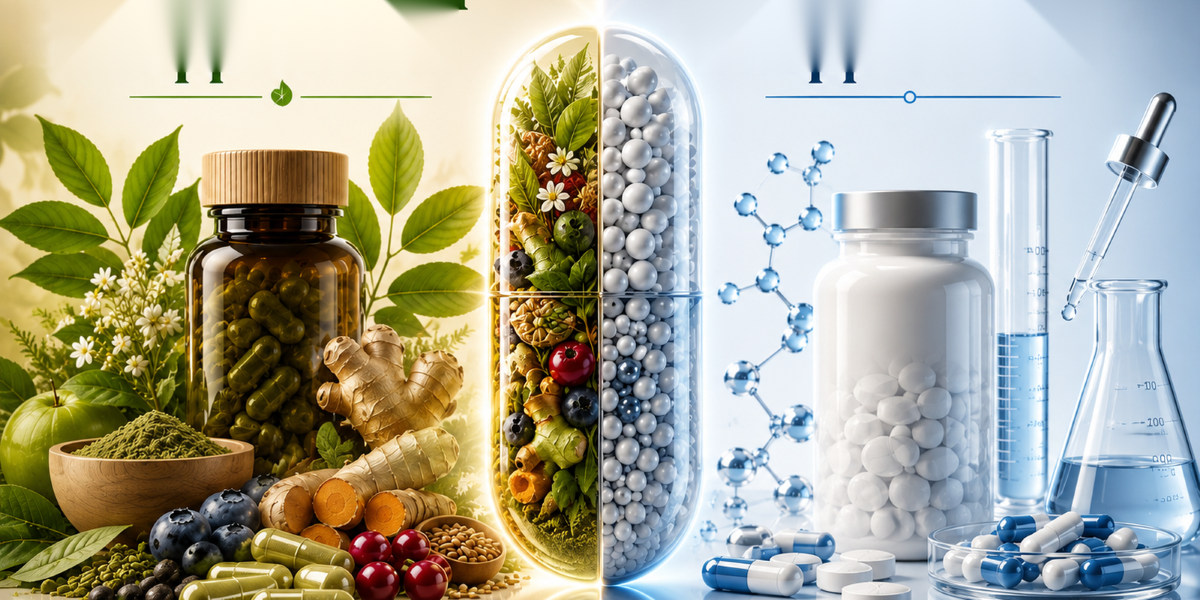


Dietary supplements are available in different forms, including products marketed as fully natural and others made with synthetic nutrients.
Understanding the difference between these supplement types can help you choose a product that fits your health needs, budget, lifestyle, and quality expectations. However, the best choice depends on the nutrient, the formula, the dose, and the reliability of the brand—not only whether the supplement is natural or synthetic.
Table of Contents
What Are Fully Natural Supplements?
Fully natural supplements are usually derived from plant, animal, marine, or food-based sources.
Examples may include vitamins extracted from fruits and vegetables, omega-3 from fish oil or algae oil, minerals from natural sources, or herbal extracts prepared from whole plants.
These products may involve processing, extraction, drying, concentration, or purification, but they are generally marketed as being closer to natural food sources.
What Are Synthetic Supplements?
Synthetic supplements are manufactured in laboratories to provide vitamins, minerals, or active ingredients that may mimic naturally occurring nutrients.
They are often easier to produce at scale, more affordable, and more stable in certain formulations.
In some cases, synthetic nutrients may be very similar to their natural forms. In other cases, the structure, form, or accompanying compounds may differ, which can influence absorption or how the body uses them.
Differences in Absorption and Effectiveness
Absorption and effectiveness depend on the specific nutrient and its chemical form, not only whether it is natural or synthetic.
Some natural or food-based supplements may contain additional compounds that support nutrient utilization. However, some synthetic forms can also be effective, especially when they are well-formulated and used at appropriate doses.
For example, mineral forms such as citrate, glycinate, oxide, or sulfate may differ in tolerance and absorption. Similarly, some vitamin forms may be more active or better suited for certain individuals than others.
| Feature | Fully Natural Supplements | Synthetic Supplements |
|---|---|---|
| Source | Plant, animal, marine, or food-based sources | Laboratory-manufactured nutrients or compounds |
| Cost | Often higher due to sourcing and processing | Often more affordable and widely available |
| Absorption | May be supported by natural co-factors depending on the product | Depends on the nutrient form, dose, and formulation quality |
| Best For | People seeking food-based or minimally processed options | People seeking affordability, consistency, or specific nutrient forms |
Practical Considerations When Choosing
Choosing a supplement should depend on more than the words “natural” or “synthetic” on the label.
Important factors include ingredient form, dosage, purity, third-party testing, brand reputation, allergen status, additives, and whether the product matches your actual health need.
Natural supplements may be preferred by people who want food-based nutrients or fewer synthetic additives, while synthetic supplements may be suitable for those who need a specific dose, stable formula, or more affordable option.
How to Read Supplement Labels
The supplement label can help you understand the source, form, and quality of the ingredients.
Look for clear ingredient names, nutrient forms, serving size, dosage, certifications, allergen warnings, and any added colors, fillers, sweeteners, or preservatives.
A transparent label is often more useful than broad marketing terms such as “natural,” “premium,” or “clean.”
Additional Tips
- Check the label to identify the ingredient source and nutrient form.
- Look for quality certifications or third-party testing when available.
- Choose a dose that matches your need rather than assuming higher is better.
- Compare active ingredient amounts, not only capsule count or price.
- Avoid products with unclear claims or hidden proprietary blends.
- Consult a doctor, pharmacist, or nutritionist if you need guidance on the most suitable option.
Frequently Asked Questions
Are natural supplements always better than synthetic supplements?
Not always. Natural supplements may be preferred by some people, but effectiveness depends on the nutrient form, dose, quality, and individual needs.
Are synthetic supplements safe?
Many synthetic supplements can be safe when used at appropriate doses and produced by reliable brands. Safety depends on quality, dosage, and personal health factors.
Do natural supplements absorb better?
Some natural or food-based supplements may offer good absorption, but this is not guaranteed. Absorption depends on the nutrient form and formulation.
How can I know if a supplement is natural?
Check the label for ingredient sources, certifications, extraction details, and whether the product clearly states plant, animal, marine, or food-based origins.
Which type should I choose?
The right choice depends on your health goal, budget, diet, tolerance, and the quality of the product. Professional guidance can help when you are unsure.
Conclusion
Understanding the difference between fully natural and synthetic supplements can help you make more informed health decisions.
The best supplement is not determined by one label claim alone. It should match your personal needs, provide an appropriate dose, come from a reliable brand, and support quality and safety without unnecessary ingredients or exaggerated claims.