

Amino acids play a vital role in muscle building, recovery, endurance, and athletic performance. They are the building blocks of protein and are essential for repairing muscle tissue after exercise.
Two of the most popular amino acid supplement categories are Essential Amino Acids (EAAs) and Branched-Chain Amino Acids (BCAAs). Although they are related, they are not the same. Understanding the difference can help athletes and health-conscious individuals choose the right supplement for muscle growth, recovery, and training support.
Table of Contents
What Are Amino Acids?
Amino acids are compounds that combine to form proteins. They support muscle repair, tissue growth, hormone production, immune function, and many other processes in the body.
For athletes, amino acids are especially important because training creates stress on muscle tissue. The body then needs enough amino acids to support repair, adaptation, and recovery.
Some amino acids can be produced by the body, while others must come from food or supplements. These are known as essential amino acids.
What Are Essential Amino Acids (EAAs)?
Essential Amino Acids, or EAAs, are nine amino acids that the body cannot produce on its own in sufficient amounts. They must be obtained through food or supplements.
These nine amino acids are leucine, isoleucine, valine, lysine, methionine, phenylalanine, threonine, tryptophan, and histidine.
EAAs provide a complete set of essential building blocks required for muscle protein synthesis, recovery, energy support, and overall protein metabolism.
- Contain all nine essential amino acids.
- Support complete muscle protein synthesis.
- Help with post-workout recovery.
- May support muscle maintenance during cutting phases.
- Useful when total protein intake is low or meal timing is limited.
What Are Branched-Chain Amino Acids (BCAAs)?
Branched-Chain Amino Acids, or BCAAs, are a subgroup of EAAs. They include only three amino acids: leucine, isoleucine, and valine.
These amino acids are called “branched-chain” because of their chemical structure. They are commonly used by athletes to support training performance, reduce perceived muscle fatigue, and stimulate muscle protein synthesis.
Leucine is especially important because it acts as a key signal for muscle protein synthesis. However, BCAAs alone do not provide all the amino acids needed to fully build new muscle protein.
| Supplement Type | Amino Acids Included | Main Focus |
|---|---|---|
| EAAs | All 9 essential amino acids | Complete muscle growth and recovery support |
| BCAAs | Leucine, isoleucine, and valine only | Targeted support for training and muscle protein synthesis signaling |
The Main Difference Between EAAs and BCAAs
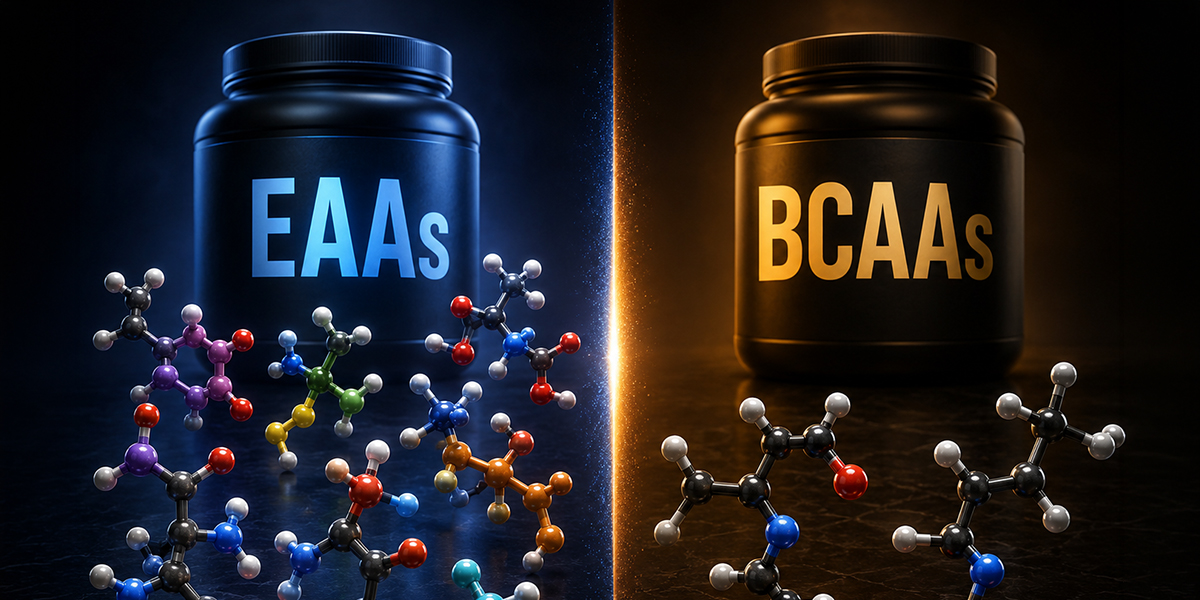
The main difference between EAAs and BCAAs is completeness.
EAAs contain all nine essential amino acids required to support full muscle protein synthesis. BCAAs contain only three essential amino acids, which can help trigger the process but do not provide the complete raw materials needed to build muscle protein on their own.
This means EAAs offer broader support for recovery, muscle maintenance, and protein balance, while BCAAs are more focused on a specific part of the muscle-building process.
| Comparison Point | EAAs | BCAAs |
|---|---|---|
| Number of Amino Acids | 9 essential amino acids | 3 essential amino acids |
| Completeness | More complete | Less complete |
| Muscle Protein Synthesis | Provides all essential building blocks | Mainly provides signaling amino acids |
| Best For | Recovery, growth, and muscle maintenance | Training support and fatigue management |
| Overall Support | Broad and comprehensive | More targeted |
Which Is Better for Muscle and Performance?
For complete muscle growth and recovery support, EAAs are generally the stronger choice because they provide all essential amino acids needed for protein synthesis.
BCAAs can still be useful in specific situations, such as during short workouts, fasted training, or when someone wants targeted support for reducing exercise-related fatigue.
However, if the goal is full recovery, muscle maintenance, and better support for lean muscle development, EAAs are usually more comprehensive than BCAAs.
When to Use EAAs or BCAAs
EAAs may be a better option when training intensity is high, daily protein intake is low, recovery is a priority, or the person is following a calorie-restricted diet.
BCAAs may be useful during workouts, especially for people who train fasted or want a light amino acid drink without taking a full protein shake.
The best choice depends on your total diet, training goal, workout timing, and recovery needs.
| Goal | Better Choice | Reason |
|---|---|---|
| Full Muscle Recovery | EAAs | Provide all essential amino acids for protein synthesis |
| Muscle Growth Support | EAAs | More complete support than BCAAs alone |
| Fasted Training Support | EAAs or BCAAs | Both may support training, but EAAs are more complete |
| Reducing Workout Fatigue | BCAAs | May help during intense exercise for some individuals |
| Cutting Phase Support | EAAs | Better for preserving lean mass when calories are low |
Frequently Asked Questions
What is the main difference between EAAs and BCAAs?
EAAs contain all nine essential amino acids, while BCAAs contain only three: leucine, isoleucine, and valine.
Are EAAs better than BCAAs?
For complete muscle recovery and muscle protein synthesis support, EAAs are generally better because they provide all essential amino acids.
Do BCAAs still have benefits?
Yes. BCAAs may support training performance, reduce perceived fatigue, and provide targeted support during workouts, especially in fasted training situations.
Can EAAs replace protein powder?
No. EAAs can support amino acid intake, but they do not replace complete protein foods or protein powders that provide a broader nutritional profile.
When should I take EAAs or BCAAs?
They are commonly taken before, during, or after training. EAAs are often better for recovery, while BCAAs may be used during workouts for targeted support.
Conclusion
Understanding the difference between EAAs and BCAAs helps you select the right supplement for your fitness, recovery, and performance goals.
EAAs provide complete essential amino acid support for muscle growth, recovery, and maintenance, while BCAAs focus on three key amino acids involved in training support and muscle protein synthesis signaling. For most people seeking complete recovery and muscle support, EAAs are the more comprehensive option, while BCAAs can still be useful in specific workout situations.