
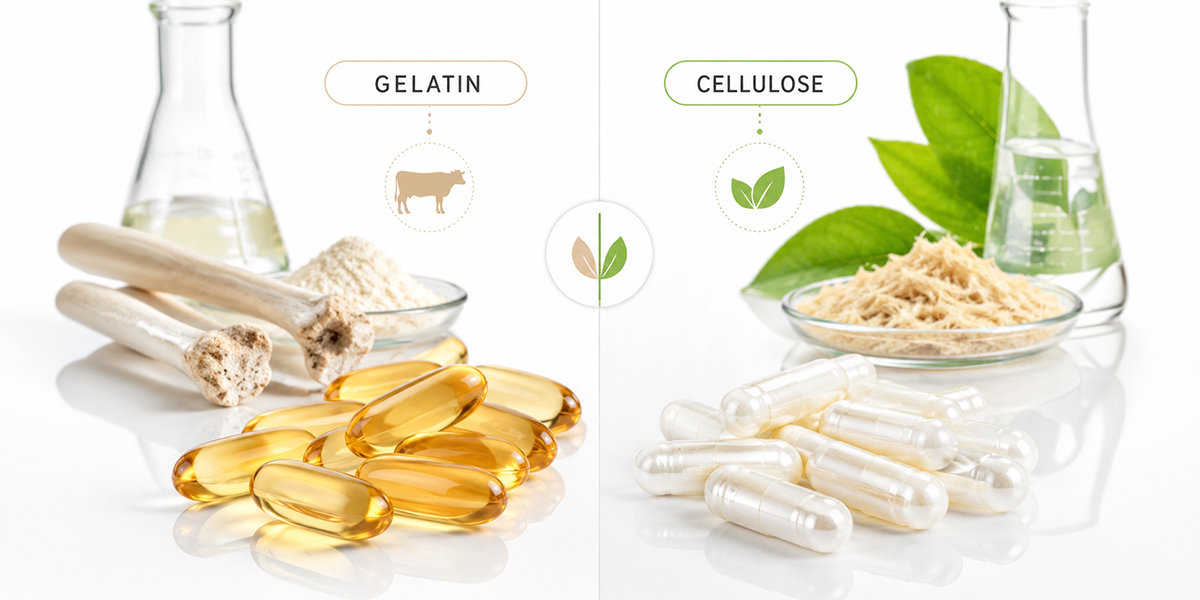


Capsules are one of the most common delivery forms used for dietary supplements, vitamins, minerals, herbal formulas, and medications.
However, not all capsules are made from the same material. The two main types are gelatin capsules, which are derived from animal sources, and vegetarian capsules, which are typically made from plant-based cellulose. Understanding the difference can help consumers choose products that match their dietary preferences, ethical values, religious considerations, and individual health needs.
Table of Contents
What Are Gelatin Capsules?
Gelatin capsules are made using gelatin obtained primarily from animal collagen.
This collagen is commonly sourced from bovine or porcine tissues, depending on the manufacturer and product specifications.
Gelatin capsules have been used for decades in the pharmaceutical and supplement industries because they are easy to manufacture, widely available, cost-effective, and designed to dissolve efficiently in the digestive system.
- Animal-based capsule material.
- Usually sourced from bovine or porcine collagen.
- Commonly used in supplements and medications.
- Often more affordable than vegetarian capsule options.
- May not be suitable for vegetarians, vegans, or people with specific religious restrictions.
What Are Vegetarian Cellulose Capsules?
Vegetarian capsules are usually made from hydroxypropyl methylcellulose, commonly known as HPMC.
HPMC is derived from plant cellulose and does not contain animal-derived ingredients, making it a preferred option for vegetarians, vegans, and individuals who avoid animal products for religious, ethical, or personal reasons.
Vegetarian capsules are commonly used in modern supplement formulas, especially products marketed as plant-based, vegan-friendly, clean-label, or allergen-conscious.
- Plant-based capsule material.
- Usually made from cellulose-derived HPMC.
- Suitable for many vegetarian and vegan users.
- Often preferred for ethical, dietary, or religious reasons.
- May be slightly more expensive than standard gelatin capsules.
Differences in Source and Suitability
The most obvious difference between gelatin and vegetarian capsules is their origin.
Gelatin capsules are animal-based, while cellulose capsules are plant-derived. This makes cellulose capsules more suitable for people who follow plant-based diets or avoid animal ingredients.
For some consumers, the capsule material is just as important as the active ingredient inside the supplement.
| Comparison Point | Gelatin Capsules | Vegetarian Cellulose Capsules |
|---|---|---|
| Source | Animal collagen, usually bovine or porcine | Plant-derived cellulose, usually HPMC |
| Dietary Suitability | Not suitable for vegetarians or vegans | Suitable for many vegetarian and vegan users |
| Cost | Usually more cost-effective | Often slightly more expensive |
| Storage Stability | May be more sensitive to humidity and temperature | Generally more resistant to humidity and temperature variation |
| Main Advantage | Long history of use and efficient manufacturing | Animal-free and suitable for broader dietary preferences |
Differences in Stability and Storage
Capsule stability can be influenced by humidity, temperature, packaging, and the type of active ingredient inside the capsule.
Vegetarian cellulose capsules are generally known for better resistance to variations in humidity and temperature, which may offer advantages during storage and transport.
Gelatin capsules can be more sensitive to environmental conditions. If exposed to excessive moisture or heat, they may become sticky, brittle, or less stable over time.
Regardless of capsule type, supplements should be stored in a cool, dry place and kept tightly closed after opening.
Differences in Dissolution
Both gelatin and vegetarian cellulose capsules are designed to dissolve and release their contents within the digestive tract.
Gelatin capsules are known for efficient dissolution, which is one reason they have been widely used for many years.
Cellulose capsules also dissolve effectively, though the exact dissolution profile may vary depending on the formula, capsule thickness, active ingredient, and manufacturing process.
For most supplement users, both capsule types can serve as effective delivery systems.
Do They Affect Nutrient Absorption?
In most cases, the capsule material itself has minimal impact on the absorption of the nutrients inside.
Factors such as the form of the active ingredient, dosage, digestive health, timing of intake, and whether the supplement is taken with food often play a much greater role in determining effectiveness.
For example, the absorption of a mineral may depend more on whether it is in citrate, glycinate, oxide, or another form than whether the capsule shell is gelatin or cellulose.
Which Type Is Better?
Neither capsule type is universally better for everyone.
Gelatin capsules may be preferred for their long history of use, cost-effectiveness, and manufacturing efficiency. Vegetarian cellulose capsules may be preferred by people who want animal-free products or follow vegan, vegetarian, religious, or personal dietary restrictions.
The best choice depends on your values, dietary needs, product quality, storage conditions, and the supplement formula itself.
- Choose gelatin capsules if cost and traditional formulation are your main priorities.
- Choose vegetarian capsules if you avoid animal-derived ingredients.
- Check the label if religious, vegan, vegetarian, or allergen concerns are important to you.
- Prioritize product quality, active ingredient form, and proper dosage.
- Store all capsules away from heat, moisture, and direct sunlight.
Frequently Asked Questions
What are gelatin capsules made from?
Gelatin capsules are usually made from gelatin obtained from animal collagen, commonly sourced from bovine or porcine tissues.
What are vegetarian capsules made from?
Vegetarian capsules are usually made from plant-derived cellulose, commonly in the form of hydroxypropyl methylcellulose, also known as HPMC.
Are vegetarian capsules better than gelatin capsules?
Not necessarily. Vegetarian capsules are better for people avoiding animal ingredients, while gelatin capsules may be more affordable and widely used. The better choice depends on individual needs.
Do capsule materials affect nutrient absorption?
Usually, the capsule material has minimal impact on nutrient absorption. The active ingredient form, dose, and digestive health are usually more important.
How can I know which capsule type is used?
Check the supplement label. It may mention gelatin, bovine gelatin, porcine gelatin, vegetarian capsule, vegan capsule, cellulose, or HPMC.
Conclusion
Gelatin capsules and vegetarian cellulose capsules differ mainly in their source and suitability for different consumer groups.
Gelatin capsules are derived from animal collagen, while cellulose capsules provide a plant-based option without compromising their role as effective supplement delivery systems. Ultimately, the choice between them is usually a matter of dietary preference, ethical values, storage considerations, and individual needs rather than a major difference in nutritional performance.