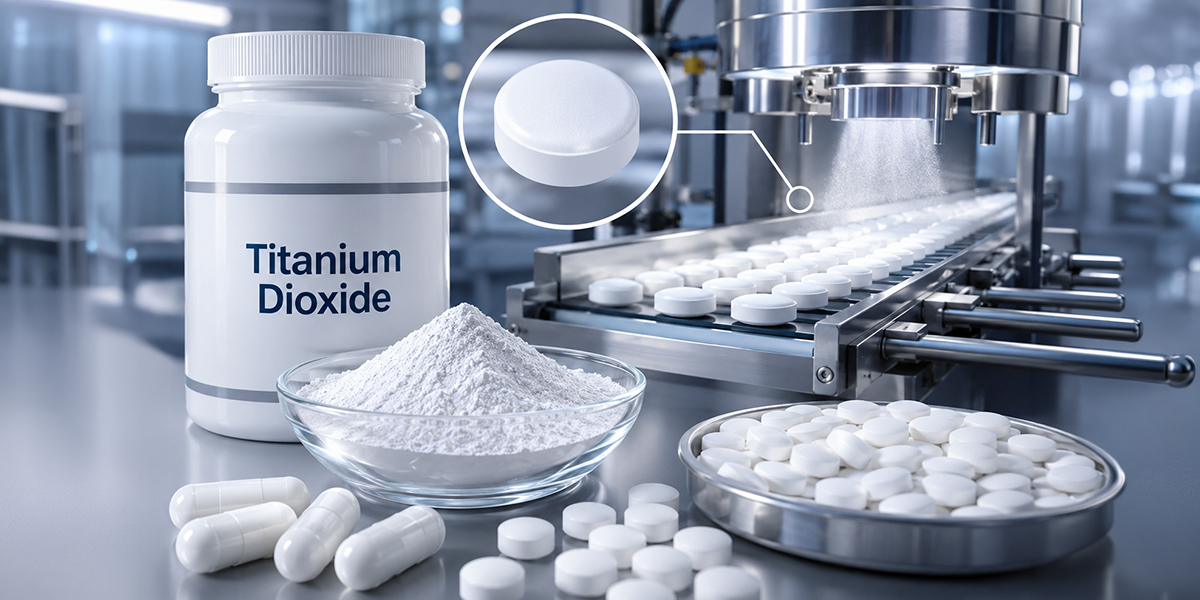


Titanium dioxide is an additive that has been used for many years in the food, pharmaceutical, and supplement industries, especially in capsules, tablets, and coated products.
It may appear on ingredient labels as Titanium Dioxide or under the code E171, which often leads consumers to ask why it is included, whether it has any nutritional value, and whether its presence is necessary in dietary supplements.
Table of Contents
What Is Titanium Dioxide?
Titanium dioxide is a white mineral compound commonly used for its coloring and opacity properties.
In supplements, it is not used as an active nutritional ingredient. It does not provide vitamins, minerals, amino acids, or other health-supporting nutrients.
Instead, its role is mainly technical and cosmetic. It helps create a bright white appearance, improves product uniformity, and can make tablets or capsules look more visually consistent.
Why Is Titanium Dioxide Used in Dietary Supplements?
Supplement ingredients can naturally vary in color depending on the raw materials, processing methods, and active nutrients used in the formula.
Manufacturers may use titanium dioxide to make capsules and tablets look more uniform, clean, and visually appealing. This can help create a consistent product appearance from batch to batch.
It may also help reduce light penetration through capsule shells or coatings, which can be useful for certain ingredients that are sensitive to light exposure.
- Helps create a bright white color.
- Improves capsule and tablet opacity.
- Masks natural color variation in raw ingredients.
- Supports a more uniform product appearance.
- May help protect some light-sensitive ingredients.
- Improves visual stability and presentation.
Does It Affect Supplement Effectiveness?
Titanium dioxide does not improve the absorption, bioavailability, potency, or effectiveness of vitamins and minerals.
Its purpose is related to manufacturing and product presentation rather than nutritional performance.
This means a supplement without titanium dioxide can still be effective if the active ingredients, dosage, formulation, and quality standards are appropriate.
| Function | Does Titanium Dioxide Help? | Explanation |
|---|---|---|
| Color and Appearance | Yes | It helps create a white, opaque, and uniform look. |
| Nutritional Value | No | It is not a vitamin, mineral, or active nutrient. |
| Absorption | No | It does not increase nutrient absorption or bioavailability. |
| Light Protection | May Help | Its opacity may reduce light exposure for some sensitive ingredients. |
Is Titanium Dioxide Safe?
Titanium dioxide has been used for decades in food, pharmaceutical, and supplement applications under regulatory limits in many countries.
However, more recent scientific discussions have raised questions about its use as a food additive, especially regarding very small particles and long-term exposure.
Because of this, some regulatory authorities have reassessed or restricted its use, while other regions may still allow it under specific conditions. This has created different regulatory positions depending on the country and product category.
Why Are Some Companies Removing It?
Many consumers now prefer supplements with cleaner, simpler, and more transparent ingredient lists.
As a result, some companies are removing titanium dioxide from their formulas even when it is still permitted in certain markets.
This shift may be driven by consumer expectations, changing regulations, brand positioning, or a desire to reduce non-essential additives.
- Growing demand for clean-label supplements.
- Consumer preference for fewer additives.
- Changing regulatory positions in some markets.
- Brand efforts to improve transparency.
- Availability of alternative color and coating systems.
Are There Alternatives?
Yes. Depending on the supplement type and manufacturing requirements, companies may use alternative ingredients or formulation strategies to achieve a similar visual effect.
Some alternatives may include mineral-based ingredients, natural colorants, different capsule materials, uncolored capsules, or coating systems designed without titanium dioxide.
However, replacing titanium dioxide is not always simple. The alternative must be compatible with the formula, stable during manufacturing, acceptable in the target market, and suitable for the product’s shelf life.
| Alternative Approach | Purpose | Consideration |
|---|---|---|
| Natural Colorants | Improve appearance using plant or food-based colors | May vary in stability and color intensity. |
| Uncolored Capsules | Avoid unnecessary coloring agents | Raw ingredient color may be more visible. |
| Alternative Coatings | Support tablet appearance and protection | Must be tested for stability and performance. |
| Opaque Capsule Materials | Reduce light exposure and improve appearance | Depends on formulation and regulatory approval. |
Frequently Asked Questions
What is titanium dioxide in supplements?
Titanium dioxide is an additive used mainly to provide a white color, improve opacity, and create a more uniform appearance in some capsules and tablets.
Is titanium dioxide a nutrient?
No. It is not an active nutritional ingredient and does not provide vitamins, minerals, or health-supporting nutrients.
Does titanium dioxide improve absorption?
No. Titanium dioxide does not improve nutrient absorption, bioavailability, or supplement effectiveness.
Why are some brands removing titanium dioxide?
Some brands are removing it due to changing consumer preferences, clean-label trends, evolving regulations, and increased demand for simpler ingredient lists.
Can supplements be made without titanium dioxide?
Yes. Many supplements can be made without it by using uncolored capsules, alternative coatings, natural colorants, or different formulation strategies.
Conclusion
Titanium dioxide is used in certain dietary supplements for cosmetic and technical purposes related to color, opacity, appearance, and sometimes protection from light.
It does not enhance nutritional value, absorption, or supplement effectiveness. Although it has been widely used under regulatory limits in many markets, ongoing scientific discussion and changing consumer expectations have encouraged many companies to explore alternatives that better align with modern clean-label preferences.