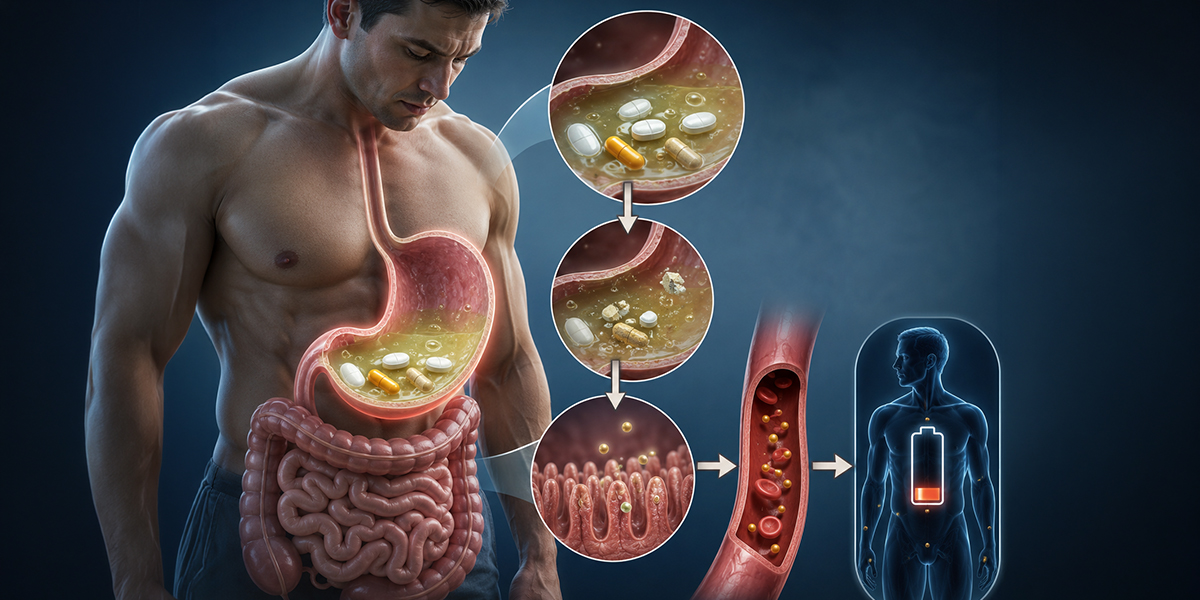


Stomach acid, also known as hydrochloric acid, plays an essential role in digestion, nutrient release, and the absorption of many vitamins and minerals.
When stomach acid levels are low, the body may struggle to break down food and supplements properly. As a result, some people may feel that supplements are “not working,” even when they take them consistently and use high-quality products.
Table of Contents
The Role of Stomach Acid in Absorption
Stomach acid helps break food into smaller particles, allowing digestive enzymes to work more effectively.
It also helps create the acidic environment needed to release and prepare certain nutrients for absorption later in the intestines.
Without enough stomach acid, digestion may become less efficient, and nutrients such as iron, zinc, calcium, magnesium, and vitamin B12 may not be absorbed as well.
How Low Stomach Acid Affects Supplements
When stomach acid is insufficient, supplements may not dissolve or break down properly inside the stomach.
This can reduce the availability of active ingredients and limit how much of the nutrient can be absorbed in the digestive tract.
In this situation, nutrients may pass through the body without being fully utilized, even if the supplement itself is well-formulated.
| Digestive Factor | What Low Stomach Acid May Cause | Possible Result |
|---|---|---|
| Poor Supplement Breakdown | Tablets or capsules may dissolve less efficiently | Lower nutrient availability |
| Reduced Enzyme Activation | Digestive enzymes may work less effectively | Incomplete digestion |
| Poor Mineral Ionization | Minerals may not become absorbable enough | Persistent deficiency symptoms |
| Reduced Nutrient Release | Nutrients may remain bound to food or supplement material | Lower absorption despite intake |
Effect on Mineral Absorption
Minerals are especially affected by stomach acidity because many of them need an acidic environment to become more soluble and easier to absorb.
Iron, zinc, calcium, and magnesium may be less efficiently absorbed when stomach acid is low, especially if the supplement form is not highly bioavailable.
This may explain why some people continue to experience symptoms of deficiency or show poor improvement in blood tests despite regular supplementation.
| Mineral | Why Stomach Acid Matters | Possible Concern with Low Acid |
|---|---|---|
| Iron | Acidity supports better conversion and absorption | Low ferritin or persistent iron deficiency |
| Zinc | Needs good digestion and mineral release | Poor immune, skin, or taste-related support |
| Calcium | Some forms depend more on stomach acid | Lower absorption, especially with carbonate forms |
| Magnesium | Absorption varies by form and digestive function | Reduced benefit from poorly absorbed forms |
Effect on Vitamin B12
Vitamin B12 absorption is strongly connected to proper stomach function.
In food, vitamin B12 is bound to dietary proteins. Stomach acid helps release B12 from these proteins so it can later bind to intrinsic factor and be absorbed in the small intestine.
When stomach acid is low, this release process may be impaired, which can contribute to poor B12 status even when dietary intake or supplementation appears adequate.
Why Some People See No Improvement
When nutrient absorption is impaired, the amount that reaches the bloodstream may be too low to create the expected benefit.
This means a person may take a supplement regularly but still experience low energy, poor focus, muscle weakness, brittle nails, hair shedding, low ferritin, or unsatisfactory blood test results.
In these cases, the issue may not be the supplement dose alone. The problem may be poor digestion, low stomach acid, poor supplement form, timing, food interactions, or an underlying digestive condition.
| Reason Supplements May Not Work | What It Means | Possible Solution |
|---|---|---|
| Low Stomach Acid | Nutrients are not released or absorbed efficiently | Assess digestive function and choose suitable forms |
| Poor Supplement Form | Some forms require stronger digestion | Use more bioavailable or gentle forms |
| Wrong Timing | Coffee, tea, fiber, or other minerals may interfere | Separate supplements from interfering foods or drinks |
| Underlying Digestive Issue | Absorption may be impaired beyond stomach acid alone | Seek professional evaluation |
Should You Increase the Dose?
Increasing the supplement dose is not always the best solution.
If the problem is absorption rather than intake, taking more may not lead to better results and may increase the risk of digestive discomfort or unnecessary excess.
A better approach may involve improving digestive function, choosing a more bioavailable supplement form, changing the timing, or addressing the underlying cause of low stomach acid.
- Do not assume a higher dose will solve poor absorption.
- Choose forms that are easier to absorb when digestion is weak.
- Take mineral supplements away from coffee, tea, and high-fiber blockers when needed.
- Consider liquid, chelated, methylated, or sublingual forms when appropriate.
- Assess stomach health if supplements repeatedly fail to improve symptoms.
- Consult a healthcare professional before changing high-dose supplement plans.
Frequently Asked Questions
Can low stomach acid make supplements less effective?
Yes. Low stomach acid may reduce the breakdown and absorption of certain supplements, especially minerals and nutrients that depend on proper digestion.
Which nutrients are most affected by low stomach acid?
Iron, zinc, calcium, magnesium, and vitamin B12 are among the nutrients that may be affected when stomach acid is low.
Why does vitamin B12 need stomach acid?
Stomach acid helps release vitamin B12 from dietary proteins, allowing it to later bind to intrinsic factor and be absorbed in the small intestine.
Should I take a higher dose if supplements do not work?
Not always. If absorption is the problem, increasing the dose may not help. It may be better to address digestion, timing, and supplement form first.
What supplement forms may be better with low stomach acid?
More bioavailable forms, such as chelated minerals, calcium citrate, methylated B vitamins, liquid forms, or sublingual B12 may be easier for some people to use, depending on the nutrient and individual need.
Conclusion
Low stomach acid can significantly reduce the effectiveness of supplements by impairing digestion, nutrient release, and absorption.
This helps explain why some individuals do not experience expected results despite taking supplements regularly. In many cases, absorption is just as important as dosage. Choosing the right supplement form, improving digestive function, optimizing timing, and addressing the underlying cause of low stomach acid can all help improve nutritional effectiveness.