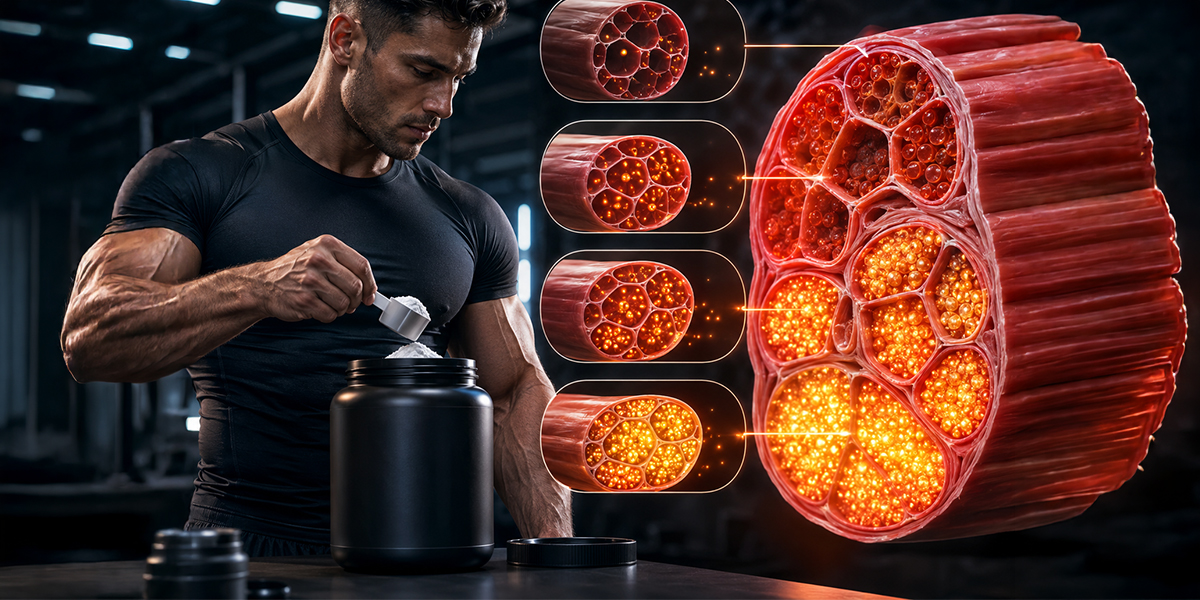


The concept of saturation is one of the most important principles in creatine supplementation. It explains how creatine gradually accumulates inside muscle cells until muscle stores become nearly full.
Understanding creatine saturation helps explain why different dosing strategies exist, why consistency matters, and why taking very high doses for long periods does not lead to unlimited extra benefits once muscle creatine stores are already close to capacity.
Table of Contents
What Is Creatine Saturation?
Creatine saturation refers to the point at which the muscles have stored a relatively high and stable amount of creatine.
Muscle tissue has a limited capacity for creatine storage. Once these stores are close to full, the body becomes less responsive to additional large doses because there is limited space left for more creatine to be retained inside the muscles.
This is why creatine is not a supplement where “more” always means “better.” The goal is not to keep increasing the dose endlessly, but to fill and maintain muscle creatine stores effectively.
How Does Saturation Occur?
Creatine saturation can happen through different dosing strategies. The two most common approaches are a loading phase or a consistent daily dose without loading.
A loading phase usually involves taking a higher amount of creatine for a short period to increase muscle stores faster. A non-loading approach uses a smaller daily dose consistently over a longer period, allowing saturation to happen gradually.
Both methods can increase muscle creatine stores. The main difference is speed, not the final goal.
| Method | How It Works | Main Advantage |
|---|---|---|
| Loading Phase | Higher intake for a short period | Reaches saturation faster |
| Daily Maintenance Approach | Smaller dose taken consistently | Simpler and gentler for many users |
| Inconsistent Use | Irregular intake with missed days | May delay or reduce saturation consistency |
What Happens After Saturation Is Reached?
Once muscle creatine stores are saturated, the body does not continue storing unlimited amounts of creatine.
At this stage, a lower maintenance dose is typically enough to help keep creatine stores elevated. Continuing to take large doses after saturation does not usually provide extra muscle storage benefits because the muscles are already near their storage limit.
Extra creatine that the body does not store may simply be processed and eliminated, making very high ongoing doses unnecessary for most healthy users.
- Muscle creatine stores become close to full.
- Large extra doses become less useful for storage.
- A maintenance dose helps keep levels stable.
- Consistency becomes more important than dose size.
- Excessive intake may increase waste without added benefit.
Why Is Saturation Important?
Creatine saturation explains why creatine works best as a consistent supplement rather than a “more is better” product.
The main purpose of creatine is to increase and maintain creatine availability inside muscle cells, where it supports rapid energy production during high-intensity exercise.
When muscles are saturated, creatine can better support repeated bursts of effort, strength performance, power output, and training volume.
| Concept | What It Means | Practical Lesson |
|---|---|---|
| Saturation | Muscles are close to full creatine storage | Maintain with consistent intake |
| Loading | Faster increase in muscle creatine stores | Useful but not mandatory |
| Maintenance | Keeps stores elevated after saturation | Best long-term strategy for most users |
| Excessive Dosing | More than the body can effectively store | Usually unnecessary after saturation |
Does Everyone Need a Loading Phase?
A loading phase is not essential for everyone.
Some people prefer loading because it helps reach saturation faster. Others prefer taking a smaller daily dose because it is simpler, easier on the stomach, and more convenient for long-term use.
Both approaches can be effective when followed consistently. The best choice depends on personal preference, tolerance, timeline, and training goals.
- Loading may be useful when faster saturation is desired.
- Daily dosing without loading can still work effectively.
- Some users prefer avoiding loading to reduce digestive discomfort.
- Consistency is the most important factor in long-term results.
- Maintenance dosing is still needed after saturation.
Creatine Saturation and Performance
Creatine saturation supports performance by helping maintain higher creatine availability inside muscle cells.
This is important because creatine contributes to the rapid recycling of ATP, the body’s immediate energy source during short, intense efforts such as sprinting, heavy lifting, jumping, and repeated high-intensity sets.
Once stores are saturated, creatine may help support strength, power, repeated effort capacity, and training quality when combined with proper training and nutrition.
| Performance Area | How Creatine Helps | Best Training Context |
|---|---|---|
| Strength | Supports rapid energy availability | Heavy resistance training |
| Power | Helps short explosive efforts | Sprints, jumps, and explosive lifts |
| Repeated Efforts | Supports ATP recycling between sets | Multiple intense sets or intervals |
| Training Volume | May help sustain work capacity | Progressive training programs |
Frequently Asked Questions
What does creatine saturation mean?
Creatine saturation means the muscles have stored creatine close to their capacity, making additional large doses less useful for increasing storage further.
Do I need a creatine loading phase?
No, a loading phase is optional. It can help reach saturation faster, but consistent daily intake without loading can also increase muscle creatine stores over time.
What happens after creatine saturation?
After saturation is reached, a lower maintenance dose is generally used to keep muscle creatine stores elevated without unnecessary high intake.
Does more creatine mean better results?
Not always. Once the muscles are saturated, taking much more creatine does not keep increasing storage and may not provide extra benefits for most users.
What matters most with creatine supplementation?
Consistency, appropriate dosing, hydration, proper training, and enough nutrition matter more than taking very high doses for long periods.
Conclusion
Creatine saturation refers to the point where muscle creatine stores become close to their storage capacity.
Once saturation is reached, continued high-dose intake is usually unnecessary, and a consistent maintenance approach becomes more practical. Understanding this concept allows for smarter creatine supplementation focused on appropriate dosing, long-term consistency, and better support for high-intensity training performance.