

Supplement labels are one of the most important tools for understanding what a product contains and how it may support your nutritional needs. Learning how to read a Supplement Facts panel can help you compare products, choose appropriate dosages, and avoid consuming too little or too much of specific nutrients.
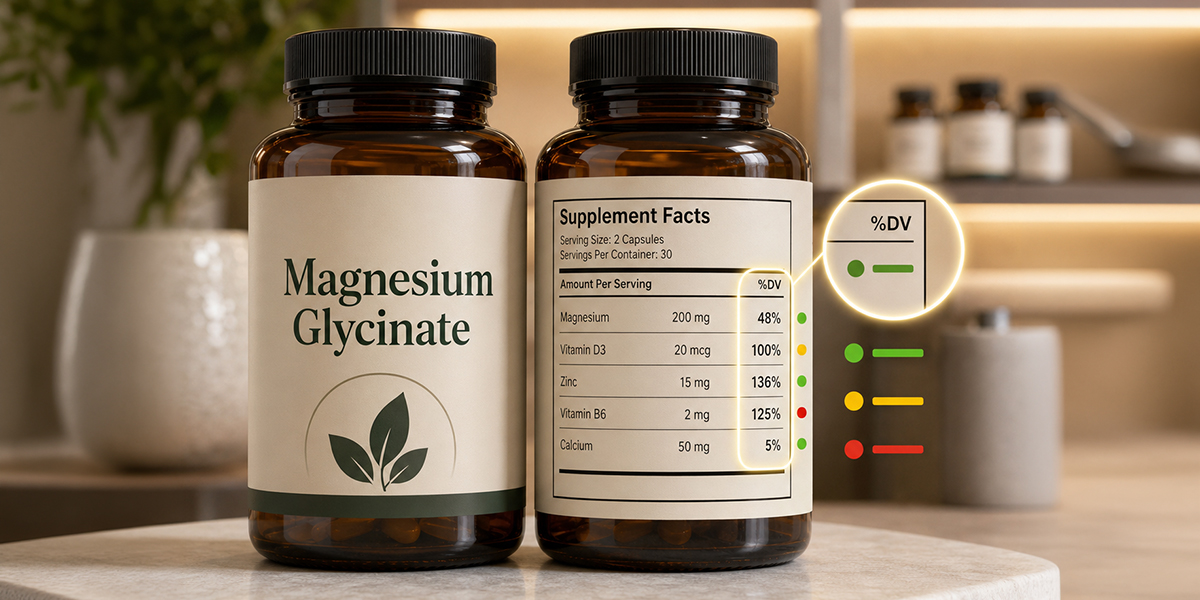
One of the most useful pieces of information on a supplement label is the “Daily Value” (%DV), which helps place nutrient amounts into context and makes it easier to evaluate a product’s contribution to your daily nutritional intake.
Table of Contents
What Is a Supplement Facts Label?
The Supplement Facts label is the section that lists the active ingredients contained in a supplement and the amount of each nutrient provided per serving.
This panel typically includes vitamins, minerals, amino acids, herbal ingredients, or other active compounds, along with serving size information and the number of servings per container.
It may also include information about inactive ingredients used during manufacturing, such as capsule materials, flavorings, stabilizers, or preservatives.
Understanding the “Daily Value” (%DV)
The Daily Value (%DV) represents the percentage of the recommended daily intake of a nutrient provided by one serving of the supplement.
For example, if a supplement provides 50% DV of Vitamin C, one serving supplies half of the daily amount considered adequate for the average healthy adult.
The %DV helps consumers quickly assess whether a supplement contains a low, moderate, or high amount of a particular nutrient.
Reading Quantities and Dosages
Always review the serving size before evaluating nutrient amounts. The listed quantities apply only to the specified serving size shown on the label.
Also check the number of servings per container. Some products may appear to contain large amounts of nutrients, but those amounts may represent multiple servings rather than a single serving.
Pay attention to:
- Serving size.
- Servings per container.
- Amount per serving.
- % Daily Value (%DV).
- Recommended usage instructions.
| Label Section | What It Means | Why It Matters |
|---|---|---|
| Serving Size | Amount considered one serving | Determines nutrient intake per use |
| Amount Per Serving | Quantity of each nutrient | Shows actual nutrient content |
| %DV | Percentage of daily requirement | Helps compare products |
| Servings Per Container | Total number of servings | Indicates product duration |
Other Ingredients and Warnings
The "Other Ingredients" section contains inactive ingredients used for manufacturing, stability, flavor, appearance, or capsule formation.
Examples may include cellulose, gelatin, natural flavors, anti-caking agents, or preservatives.
You should also review warning statements carefully, particularly if you are pregnant, breastfeeding, taking medications, or managing a medical condition.
Practical Tips for Comparing Supplements
Comparing supplements effectively requires more than looking at the nutrient amount alone.
- Compare products using %DV as well as nutrient quantity.
- Review serving sizes before comparing labels.
- Check the form of vitamins and minerals used.
- Evaluate inactive ingredients and allergens.
- Consider overall product quality and transparency.
Remember that supplements are intended to complement a balanced diet, not replace healthy eating habits.
Consulting a healthcare professional can help determine whether a supplement is appropriate for your specific needs and goals.
Frequently Asked Questions
What does %DV mean?
%DV stands for Daily Value and indicates the percentage of the recommended daily intake provided by one serving.
Does a higher %DV always mean a better supplement?
Not necessarily. The ideal amount depends on individual needs and the nutrient being evaluated.
Why is serving size important?
Because all nutrient amounts and %DV values are based on the stated serving size.
Should I compare supplements only by nutrient quantity?
No. You should also consider serving size, %DV, ingredient quality, and nutrient form.
Can supplements replace a healthy diet?
No. Supplements are designed to complement a balanced diet, not replace nutritious foods.
Conclusion
Understanding how to read a Supplement Facts label and interpret the Daily Value (%DV) can help you make more informed decisions when selecting dietary supplements.
By reviewing serving sizes, nutrient quantities, ingredient lists, and safety information, you can choose products that better match your nutritional needs while avoiding unnecessary deficiencies or excessive intake. Careful label reading remains one of the most valuable skills for making smarter supplement choices.