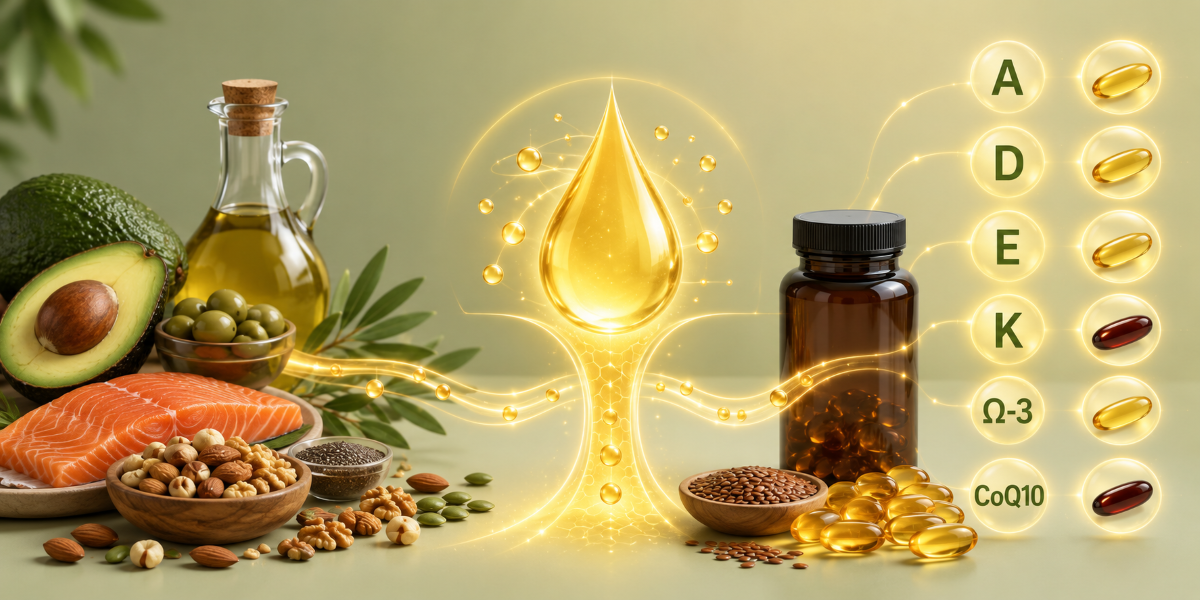


Not all supplements are absorbed in the same way. Some nutrients dissolve easily in water, while others require dietary fat to be absorbed efficiently by the body.
Understanding which supplements are fat-dependent can help maximize their effectiveness and ensure that the body gets the greatest benefit from each dose. Vitamins A, D, E, and K, along with omega-3 fatty acids and CoQ10, are among the most common nutrients best taken with a fat-containing meal.
Table of Contents
Why Does Fat Improve Absorption?
Certain vitamins and nutrients are classified as fat-soluble, meaning they dissolve in fats rather than water.
During digestion, dietary fats stimulate bile release and digestive processes that help transport fat-soluble nutrients through the intestinal wall and into the bloodstream.
Without enough dietary fat in the meal, absorption of these nutrients may be reduced, especially when supplements are taken on an empty stomach or with a very low-fat meal.
Vitamin A
Vitamin A is a fat-soluble vitamin that plays an important role in vision, immune function, skin health, and normal cell growth.
Taking vitamin A with a meal that contains healthy fats may help improve absorption and support better utilization by the body.
Because vitamin A can accumulate in the body when taken in high doses, supplementation should be used carefully and according to individual needs.
Vitamin D
Vitamin D is well known for supporting bone health, muscle function, immune health, and calcium absorption.
Because vitamin D is fat-soluble, taking it with a meal that contains dietary fat may enhance absorption compared with taking it on an empty stomach.
This is especially important for people using vitamin D supplements to correct low levels or maintain healthy vitamin D status over time.
Vitamin E
Vitamin E is a fat-soluble antioxidant that helps protect cells from oxidative stress.
Like other fat-soluble vitamins, vitamin E is generally absorbed more efficiently when taken with foods that contain fat.
Healthy fat sources may support better absorption and help the body use vitamin E more effectively.
| Supplement | Why Take with Fat? | Good Meal Pairing |
|---|---|---|
| Vitamin A | Fat-soluble and supports vision, immunity, and skin | Eggs, avocado, olive oil, or nuts |
| Vitamin D | Fat-soluble and supports calcium absorption and bone health | Yogurt with nuts, eggs, or fatty fish |
| Vitamin E | Fat-soluble antioxidant | Seeds, nuts, avocado, or olive oil |
| Vitamin K | Fat-soluble and supports clotting and bone health | Leafy greens with olive oil |
| Omega-3 | A fat-based supplement that absorbs better with meals | Main meal containing healthy fats |
| CoQ10 | Poorly soluble in water and better absorbed with fat | Meal with olive oil, nuts, eggs, or avocado |
Vitamin K
Vitamin K supports normal blood clotting and contributes to bone health.
Since vitamin K belongs to the fat-soluble vitamin family, consuming it with a meal that contains fat may help improve absorption.
Leafy green vegetables paired with olive oil, avocado, or nuts can be a practical way to support vitamin K intake from food and improve fat-soluble nutrient absorption.
Omega-3 Fatty Acids
Omega-3 supplements are themselves a form of dietary fat, usually providing EPA and DHA from fish oil, krill oil, algae oil, or similar sources.
Taking omega-3 supplements with a meal that contains fat may improve digestion, absorption, and overall bioavailability.
It may also reduce the chance of digestive discomfort, fishy burps, or reflux in some individuals.
Coenzyme Q10
Coenzyme Q10, also known as CoQ10, is a fat-soluble compound involved in cellular energy production.
Because CoQ10 is poorly soluble in water, taking it with a meal that contains healthy fats may significantly improve absorption.
This is especially useful for people using CoQ10 for energy support, heart health support, or general wellness.
Choosing the Right Meal
A meal does not need to be extremely high in fat to support absorption. Moderate amounts of healthy fats are usually enough.
Good options include olive oil, avocados, nuts, seeds, eggs, full-fat yogurt, fatty fish, or meals that naturally contain healthy fats.
- Take fat-soluble vitamins with a balanced meal rather than on an empty stomach.
- Add olive oil to salads when taking vitamins A, D, E, or K.
- Pair omega-3 or CoQ10 with lunch or dinner for better tolerance.
- Avoid very low-fat meals when taking fat-soluble supplements.
- Check labels to avoid taking multiple high-dose fat-soluble vitamins together unnecessarily.
Frequently Asked Questions
Which vitamins should be taken with fat?
Vitamins A, D, E, and K are fat-soluble vitamins and are generally absorbed better when taken with dietary fat.
Should omega-3 be taken with food?
Yes. Taking omega-3 with a meal may improve absorption and reduce digestive discomfort or fishy aftertaste in some people.
Is CoQ10 better with fat?
Yes. CoQ10 is fat-soluble and poorly soluble in water, so taking it with a fat-containing meal may improve absorption.
How much fat is needed for absorption?
A moderate amount of healthy fat is usually enough. Examples include olive oil, avocado, nuts, seeds, eggs, or fatty fish.
Can fat-soluble vitamins be taken on an empty stomach?
They can be taken on an empty stomach, but absorption may be lower, and some people may experience digestive discomfort.
Conclusion
Vitamins A, D, E, and K, along with omega-3 fatty acids and CoQ10, are nutrients that are generally absorbed more efficiently when consumed with dietary fat.
Pairing these supplements with a balanced meal containing healthy fats can help maximize bioavailability, improve tolerance, and support their intended benefits safely and effectively.