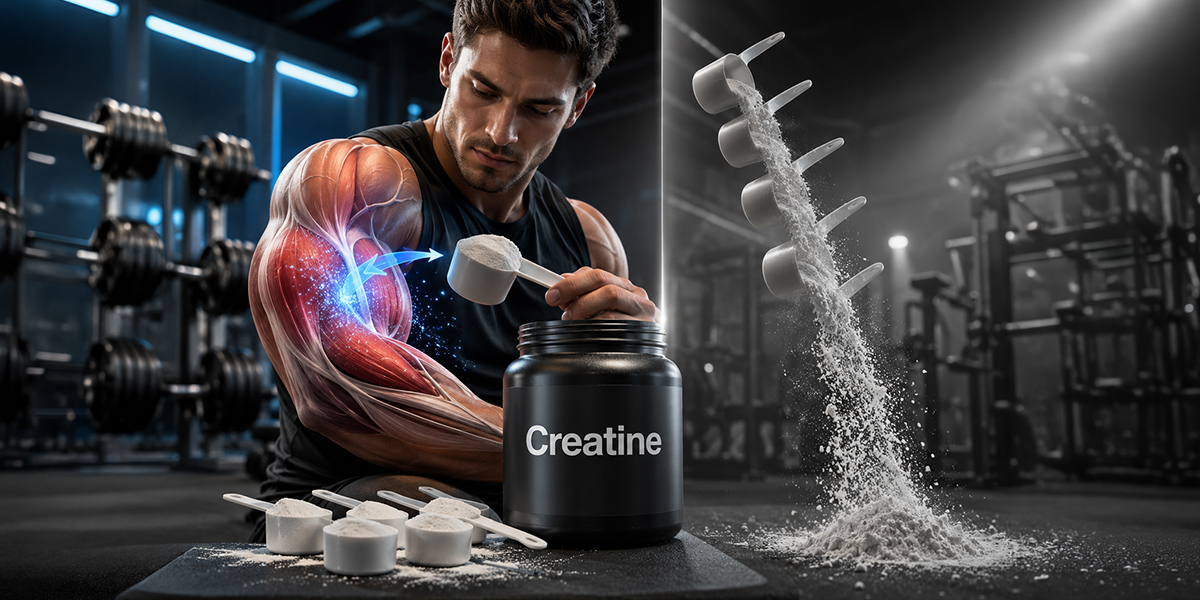


The loading phase is one of the most debated topics when using creatine supplements. Some athletes use it to achieve faster results, while others avoid it because they believe it is unnecessary or may cause discomfort.
Understanding how the loading phase works helps you decide whether it fits your goals. In simple terms, creatine loading is not essential, but it can be useful when faster muscle saturation is desired.
Table of Contents
What Is the Creatine Loading Phase?
The loading phase involves taking a higher dose of creatine for a short period, usually 5 to 7 days.
The goal is to rapidly increase and saturate creatine stores inside the muscles. After this phase, the dose is reduced to a lower maintenance amount to keep muscle creatine levels elevated.
A common loading approach is to divide the daily amount into smaller servings throughout the day instead of taking one large dose at once.
Scientific Impact of the Loading Phase
The main advantage of the loading phase is speed. It increases muscle creatine stores more quickly than taking a small daily dose from the beginning.
This may lead to faster improvements in strength, power, repeated high-intensity performance, and training capacity during the first few weeks.
However, once muscle creatine stores become saturated, the long-term benefits are generally similar whether a loading phase was used or not.
- Loading raises muscle creatine stores faster.
- It may produce quicker early performance improvements.
- It does not usually provide extra long-term benefits.
- Maintenance dosing is still needed after loading.
- The final result can be similar with or without loading.
Can the Loading Phase Be Skipped?
Yes, the loading phase can be skipped.
Muscle creatine saturation can still be achieved by taking a consistent lower daily dose. This approach takes longer, usually around 3 to 4 weeks, but the final creatine stores can reach a similar level.
For many users, especially beginners or those who are not preparing for a specific event, skipping the loading phase is simple, practical, and easier on digestion.
| Approach | How It Works | Best For |
|---|---|---|
| Loading Phase | Higher dose for 5 to 7 days, followed by maintenance | Athletes who want faster saturation and quicker early results |
| No Loading | Consistent lower daily dose for several weeks | Users who prefer a simple routine with less digestive risk |
| Long-Term Outcome | Both methods can saturate muscle creatine stores | Similar benefits when used consistently |
Potential Side Effects of Loading
Because the loading phase uses higher doses, some individuals may experience temporary digestive discomfort, stomach heaviness, bloating, or loose stools.
Some users may also notice a small increase in body weight due to increased water content inside the muscles. This is not the same as fat gain or water retention under the skin.
These effects are usually temporary and can often be reduced by splitting doses, taking creatine with food, and drinking enough water.
When Is the Loading Phase Useful?
The loading phase may be useful when someone wants to experience the benefits of creatine more quickly.
This may apply to athletes starting an intense training cycle, individuals preparing for a competition, or users who want faster increases in muscle creatine stores.
For people who are not in a hurry, a consistent daily dose without loading is usually a practical and safe option.
- Useful before a competition or intense training block.
- Helpful when faster performance support is desired.
- Not required for general fitness users.
- May not be ideal for people with sensitive digestion.
- Works best when followed by a maintenance dose.
Loading vs. No Loading: Which Is Better?
Neither method is automatically better for everyone.
Loading is better if the goal is faster saturation. No loading is better if the goal is simplicity, comfort, and long-term consistency.
The most important factor is regular use. Creatine works by gradually increasing muscle creatine stores, so consistency matters more than whether you choose to load or not.
| Goal | Suggested Option | Reason |
|---|---|---|
| Fast results | Loading phase | Saturates muscles more quickly |
| Sensitive stomach | No loading | Lower daily dose may be easier to tolerate |
| Long-term use | Either method | Final benefits are usually similar with consistency |
| Simple routine | No loading | Easy to follow daily without dose changes |
Frequently Asked Questions
Is the creatine loading phase necessary?
No. The loading phase is not necessary. It only helps saturate muscle creatine stores faster.
Is loading creatine a waste?
No. It is not a waste if faster results are the goal. However, it is optional because similar long-term benefits can be achieved without loading.
Can I take creatine without loading?
Yes. A consistent low daily dose can saturate the muscles over time, usually within several weeks.
Does loading cause bloating?
Some people may feel digestive bloating from high doses. Splitting doses, taking creatine with food, and staying hydrated may reduce discomfort.
Which method is better for beginners?
For most beginners, starting with a simple daily dose without loading is often easier and more comfortable. Loading can be used if faster saturation is desired.
Conclusion
The creatine loading phase is not essential, but it is not a waste either. It is simply a method to reach muscle creatine saturation faster.
Long-term benefits are generally similar whether you load or not, as long as creatine is used consistently. The best choice depends on your goal, timeline, digestion, and preference for either faster results or a simpler daily routine.