

Introduction
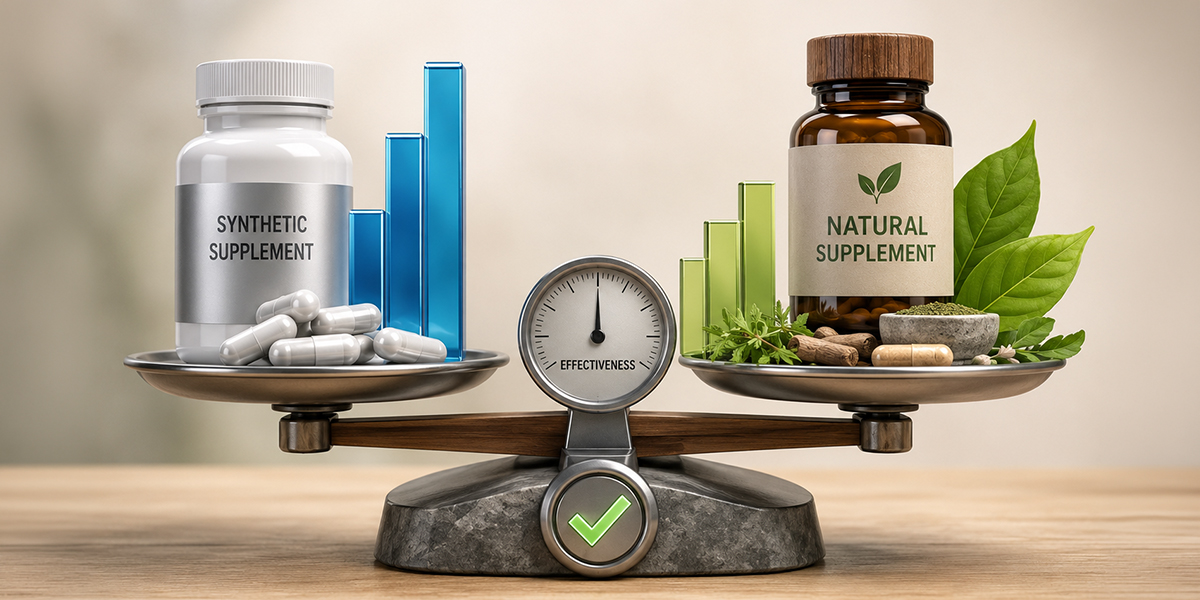
A common belief is that natural supplements are always lower in strength than synthetic ones. This assumption often arises because many whole food-based products contain nutrients in amounts closer to those naturally found in foods.
However, the relationship between natural origin and supplement potency is more complex. A supplement's strength depends on formulation, extraction method, ingredient concentration, bioavailability, and intended use.
Table of Contents
What Determines Potency?
The concentration of a supplement depends primarily on its formulation and manufacturing process rather than whether it is natural or synthetic.
A product's potency is influenced by:
- The amount of active ingredients per serving.
- The extraction or processing method used.
- The nutrient form or chemical structure.
- The intended purpose of the supplement.
- The quality and standardization of the ingredients.
Why Do Some Natural Supplements Contain Lower Amounts?
Whole food-based supplements are sometimes formulated to reflect nutrient levels typically obtained from food.
Because they may include a broader range of naturally occurring compounds, manufacturers may choose moderate nutrient concentrations rather than extremely high doses.
This does not automatically make them weak. In some cases, the presence of additional plant compounds, enzymes, or cofactors may support the overall nutritional profile.
Can Natural Supplements Be Highly Concentrated?
Yes. Natural supplements can be highly concentrated when advanced extraction and processing methods are used.
For example, plant extracts may deliver meaningful amounts of specific nutrients, antioxidants, or phytochemicals while still being derived from natural sources.
Common examples include:
- Standardized turmeric extract.
- Green tea extract.
- Milk thistle extract.
- Ginseng extract.
- Concentrated berry or herbal extracts.
Does Lower Potency Mean Lower Effectiveness?
Not necessarily. Effectiveness depends on multiple factors beyond the number shown on the supplement label.
Important factors include:
- Bioavailability.
- Nutrient form.
- Digestive tolerance.
- Ingredient quality.
- Individual nutritional needs.
- Consistency of use.
A lower numerical dose does not automatically indicate a weaker product, just as a higher dose does not guarantee better results.
Why Are Synthetic Supplements Often Higher in Dose?
Synthetic nutrients are generally easier and less expensive to manufacture in large quantities.
This makes it practical to formulate products containing very high percentages of the recommended daily intake.
In some cases, higher amounts are used to compensate for absorption variability or to meet specific product positioning goals.
Which Is Better?
Neither natural nor synthetic supplements are inherently superior based only on concentration.
The better choice depends on:
- Your nutrition goals.
- Your current diet.
- Your tolerance and digestion.
- The quality of the product.
- The form and dosage of the active ingredient.
- Whether the supplement fits your personal health needs.
Practical Tips for Choosing Supplements
- Read the active ingredient amount per serving.
- Check whether the extract is standardized.
- Look for reputable brands and transparent labels.
- Avoid unnecessary mega-doses unless recommended by a professional.
- Choose the form that best matches your health goal and tolerance.
FAQ
1. Are natural supplements always weaker than synthetic ones?
No. Some natural supplements are moderate in strength, while others are highly concentrated through extraction and standardization.
2. Does a higher dose always mean better results?
Not always. Higher doses may not improve results and can sometimes increase the risk of side effects.
3. What does standardized extract mean?
A standardized extract contains a guaranteed amount of specific active compounds, helping improve consistency between batches.
4. Are whole food-based supplements better?
They may be useful for people who prefer food-based nutrition, but their effectiveness depends on formulation, dosage, and individual needs.
5. How should I choose between natural and synthetic supplements?
Compare the ingredient form, dosage, bioavailability, product quality, and your personal health goals rather than focusing only on origin.
Conclusion
Natural supplements are not always lower in potency. While some whole food-based products provide more moderate nutrient levels, others can be highly concentrated through specialized extraction and standardization methods.
Ultimately, potency should be evaluated in the context of bioavailability, formulation quality, dosage, safety, and individual requirements rather than the natural or synthetic origin of the supplement alone.