
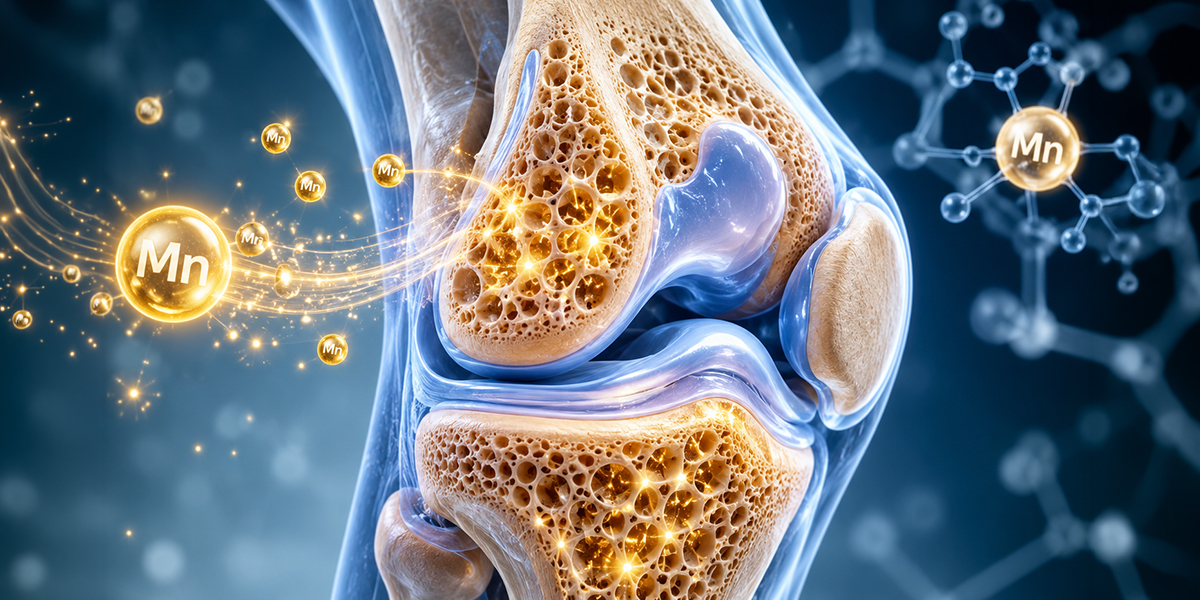


Manganese is a trace mineral that the body needs in small amounts, yet it plays an important role in maintaining healthy bones, joints, cartilage, and connective tissues.
Although it is required in much smaller quantities than minerals such as calcium or magnesium, manganese supports several biological processes involved in skeletal strength, joint flexibility, cartilage structure, and long-term musculoskeletal health.
Table of Contents
Why Manganese Matters for Bones and Joints
Manganese is involved in enzyme systems that help the body build and maintain structural tissues.
These tissues include bones, cartilage, tendons, ligaments, and other connective tissues that support movement, stability, and joint function.
Because cartilage and connective tissue are constantly exposed to mechanical stress, adequate intake of supportive nutrients such as manganese may help maintain flexibility, resilience, and normal repair processes.
Manganese and Bone Formation
Manganese helps activate several enzymes involved in normal bone development and maintenance.
It contributes to the formation of the bone matrix, which is the structural framework that gives bones their strength and rigidity.
Manganese also works alongside other important bone-supporting nutrients, including calcium, magnesium, vitamin D, vitamin K, zinc, and protein. Together, these nutrients help support bone density, skeletal strength, and healthy bone remodeling over time.
| Nutrient | Role in Bone Health | How It Works with Manganese |
|---|---|---|
| Manganese | Supports bone matrix and enzyme activity | Helps build structural components of bone |
| Calcium | Main mineral for bone strength | Provides mineral density and rigidity |
| Magnesium | Supports bone mineral balance | Works with calcium and vitamin D metabolism |
| Vitamin D | Helps calcium absorption | Supports proper mineral use in bones |
| Vitamin K | Supports calcium placement in bone tissue | Helps maintain proper bone mineralization |
Role in Cartilage and Connective Tissue Formation
Manganese plays an important role in the synthesis of proteoglycans and glycosaminoglycans, which are structural components of cartilage and connective tissues.
These compounds help cartilage retain water, absorb shock, reduce friction between bones, and maintain smooth joint movement.
Manganese also supports the integrity of tendons and ligaments, which help stabilize joints and reduce the risk of strain during movement, exercise, and daily activity.
- Supports cartilage structure and flexibility.
- Helps form proteoglycans and glycosaminoglycans.
- Contributes to shock absorption inside joints.
- Supports tendons and ligaments.
- May help maintain joint stability during physical activity.
| Tissue Type | Manganese-Supported Function | Why It Matters |
|---|---|---|
| Cartilage | Supports structural compounds | Helps cushion joints and reduce friction |
| Ligaments | Supports connective tissue strength | Helps stabilize joints |
| Tendons | Supports tissue structure and repair | Helps movement and muscle attachment |
| Bone Matrix | Supports structural framework formation | Helps maintain skeletal strength |
Antioxidant Role and Joint Protection
Manganese is a key component of manganese superoxide dismutase, also known as Mn-SOD.
Mn-SOD is one of the body’s important antioxidant enzymes inside the mitochondria, where it helps protect cells from oxidative stress.
Oxidative stress may contribute to inflammation, cartilage breakdown, and age-related joint damage. By supporting antioxidant defense, manganese may help protect joint tissues from stress related to aging, inflammation, and physical strain.
Manganese Deficiency and Its Impact
Manganese deficiency is considered uncommon, especially in people who eat a varied diet rich in whole foods.
However, low manganese intake may negatively affect processes related to bone formation, cartilage structure, connective tissue integrity, and antioxidant protection.
In theory, inadequate manganese status may contribute to reduced bone strength, delayed skeletal development, weaker connective tissue support, and slower recovery from tissue stress or injury.
| Possible Concern | How Low Manganese May Contribute | Related Area |
|---|---|---|
| Reduced Bone Strength | Less support for bone matrix formation | Skeletal health |
| Poor Cartilage Support | Reduced formation of cartilage components | Joint cushioning |
| Connective Tissue Weakness | Lower support for tendons and ligaments | Joint stability |
| Increased Oxidative Stress | Lower support for Mn-SOD antioxidant activity | Cell and joint protection |
Dietary Sources of Manganese
Manganese is naturally found in many plant-based foods, especially whole grains, nuts, seeds, legumes, leafy greens, and tea.
For most people, a balanced diet that includes whole, minimally processed foods can provide enough manganese without the need for supplementation.
Supplementation may only be considered in specific cases where intake is low or there is a professional recommendation.
- Whole grains such as oats, brown rice, and whole wheat.
- Nuts such as almonds, hazelnuts, and walnuts.
- Seeds such as pumpkin seeds, sesame seeds, and flaxseeds.
- Legumes such as lentils, chickpeas, and beans.
- Leafy green vegetables.
- Tea and some plant-based beverages.
- Pineapple and other manganese-containing fruits.
Frequently Asked Questions
Why is manganese important for bones?
Manganese helps activate enzymes involved in bone matrix formation, which supports normal bone structure, strength, and skeletal maintenance.
Does manganese support cartilage?
Yes. Manganese supports the formation of proteoglycans and glycosaminoglycans, which are important structural components of cartilage and connective tissues.
Can manganese protect joints from oxidative stress?
Manganese is part of the antioxidant enzyme Mn-SOD, which helps protect cells from oxidative stress that may contribute to cartilage damage and joint aging.
Is manganese deficiency common?
Manganese deficiency is uncommon in people who eat a balanced diet, but low intake may affect bone, cartilage, and connective tissue support over time.
Should I take manganese supplements for joint health?
Most people can obtain manganese from food. Supplements should only be used when needed and preferably under professional guidance, because excessive manganese intake may be harmful.
Conclusion
Manganese is an essential trace mineral that supports bone and joint health through its roles in bone matrix formation, cartilage structure, connective tissue strength, and antioxidant defense.
Maintaining a varied diet rich in natural manganese sources can help support skeletal strength, joint mobility, cartilage resilience, and long-term musculoskeletal health. Since the body needs manganese only in small amounts, balance is important, and high-dose supplementation should be approached with caution.